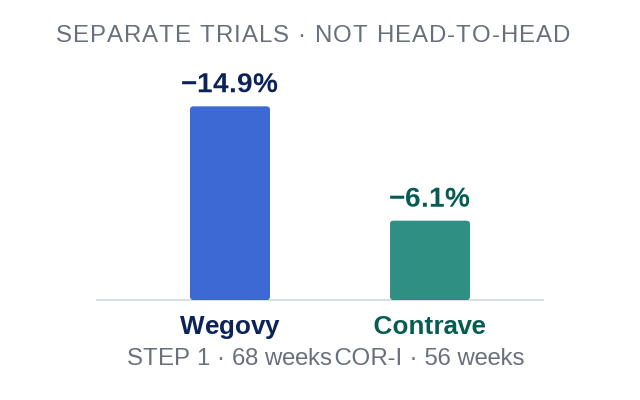
Wegovy's trials reported larger average weight reductions than Contrave's COR-I trial, but these were separate placebo-controlled studies. Their numbers do not establish a direct randomized comparison or a reliable “times more effective” ratio. The useful comparison includes the exact Wegovy formulation, each medicine's safety limits and personal access. For brand-name medication with a doctor attached, the GoodLife Health review explains how a $299 monthly primary-care membership is billed apart from the pharmacy.
Different medicines and formulations
Contrave combines naltrexone, an opioid antagonist, and bupropion, an antidepressant ingredient, in an extended-release tablet taken morning and evening. Wegovy contains semaglutide, a GLP-1 receptor agonist, as a weekly injection or daily adult tablet. Its current label includes 25 mg tablets and a 7.2 mg weekly injection option for adult weight reduction under specified conditions.[4][5] Tablet and injection milligram doses are not interchangeable.
What the separate trials reported
Swipe to see all columns
| Study | Participants and endpoint | Mean weight change |
|---|---|---|
| COR-I: naltrexone-bupropion | n = 1,742 adults randomized across 3 groups; 56 weeks | −6.1% with 32 mg naltrexone/360 mg bupropion daily vs −1.3% placebo[1] |
| STEP 1: semaglutide injection | n = 1,961 adults without diabetes; 68 weeks | −14.9% with 2.4 mg weekly vs −2.4% placebo[2] |
| OASIS 4: semaglutide tablet | n = 307 adults without diabetes; week 64 endpoint | −13.6% with 25 mg daily vs −2.2% placebo[3] |
Only 50% of COR-I participants completed 56 weeks; 83% entered its primary analysis. STEP 1's primary analysis estimated effects regardless of discontinuation or rescue treatment. Those differences make a simple ratio of the reported percentages misleading.[1][2]OASIS 4 compared the tablet with placebo, rather than Contrave or injectable Wegovy; it cannot establish tablet-versus-injection equivalence.[3] None of these three trials tested Wegovy 7.2 mg.
- Wegovy 2.4 mg: STEP 114.9%
- Naltrexone-bupropion: COR-I6.1%
Safety can change the decision
The boxed warning covered in our Contrave side-effect guide concerns suicidal thoughts and behaviors related to the drug's antidepressant ingredient. Contraindications include uncontrolled hypertension, seizure disorders, anorexia or bulimia, chronic opioid use and other bupropion-containing products. Contrave can raise blood pressure and heart rate. Cardiovascular morbidity and mortality benefit has not been established.[4]
Wegovy carries a thyroid C-cell tumor boxed warning and is contraindicated with a personal or family history of medullary thyroid carcinoma or MEN 2. Its precautions include pancreatitis, gallbladder disease and severe gastrointestinal reactions.[5] Trial adverse-event rates from different studies should not be used to declare either medicine safer overall.
How to use this comparison
The semaglutide trial averages were larger, but a personal choice also depends on medical history, adverse effects, dosing routine and coverage for the exact product. Both medicines have oral options; being a pill alone does not distinguish Contrave. Compare your actual insurance benefits and total costs rather than assuming one brand is always easier to obtain.
For other direct comparisons, read Zepbound versus Wegovy or Wegovy versus Saxenda. The Wegovy cost guide and provider comparison cover access considerations.